Table of Contents
ToggleUnderstanding Transformers in Machine Learning
Transformers represent a groundbreaking architecture in the field of artificial intelligence, revolutionizing how models process sequential data. Introduced in the seminal paper “Attention is All You Need” by Vaswani et al. in 2017, transformers have become the backbone of many state-of-the-art systems, particularly in natural language processing. Unlike traditional recurrent neural networks, which handle data sequentially and can struggle with long-range dependencies, transformers utilize self-attention mechanisms to weigh the importance of different parts of the input simultaneously. This allows for more efficient parallel processing and better capture of contextual relationships in data.
The Core Components of Transformers
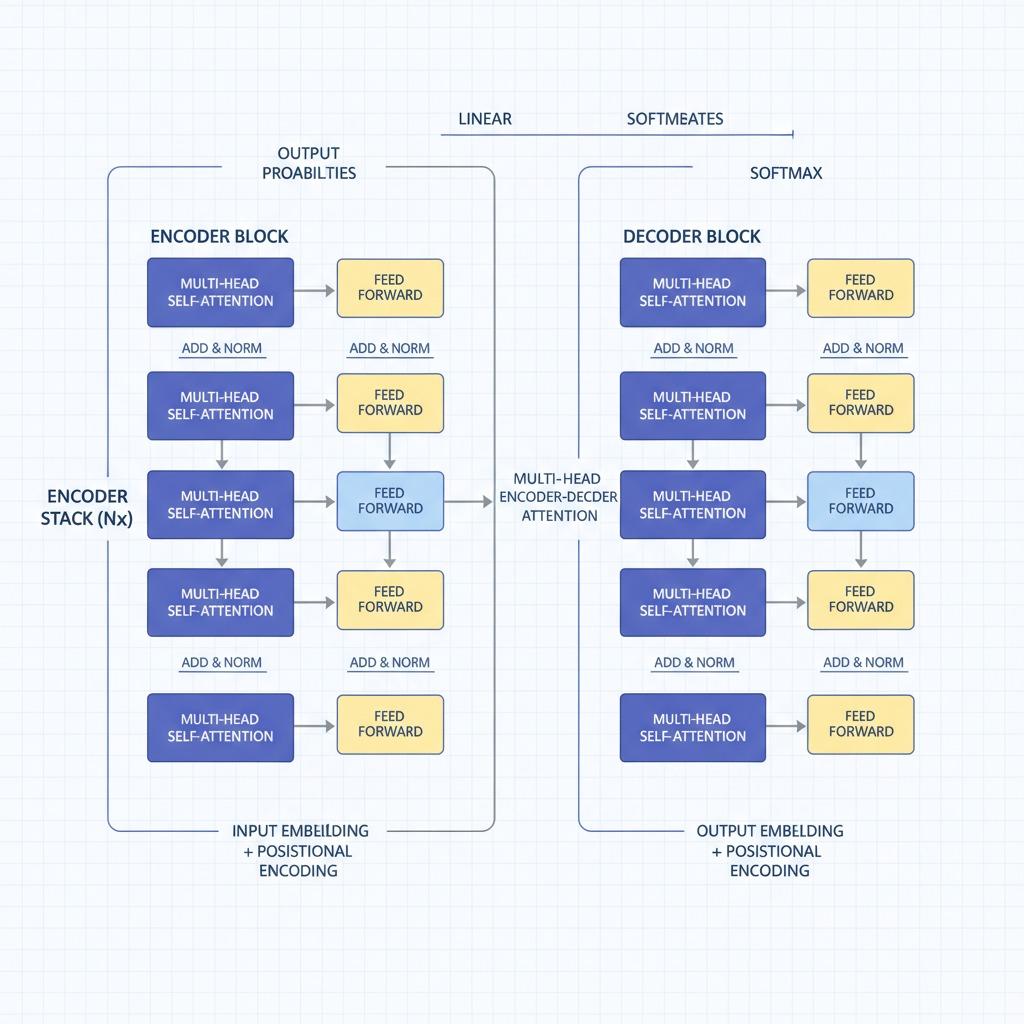
At the heart of transformers are the encoder and decoder stacks, each consisting of multiple identical layers. The encoder processes input sequences, such as sentences in a language, by passing them through self-attention layers that compute relationships between words. Positional encodings are added to the input embeddings to preserve sequence order, since transformers do not inherently understand position. The decoder, on the other hand, generates output sequences, incorporating both self-attention and encoder-decoder attention to align output with input contexts. Multi-head attention is a key innovation, allowing the model to jointly attend to information from different representation subspaces at different positions. Feed-forward networks and layer normalization further refine the representations, ensuring stable training dynamics.
Applications and Impact of Transformers
Transformers have permeated various domains beyond language tasks. In computer vision, models like Vision Transformers (ViT) apply the architecture to image patches, achieving competitive performance on classification tasks. They power translation systems like Google Translate, text generation in GPT models, and even protein structure prediction in AlphaFold. The scalability of transformers enables training on massive datasets, leading to emergent abilities in large models, such as few-shot learning. However, challenges remain, including high computational demands and the need for vast amounts of data, prompting research into efficient variants like sparse transformers or distillation techniques. Overall, transformers continue to drive innovation, making complex AI tasks more accessible and powerful.